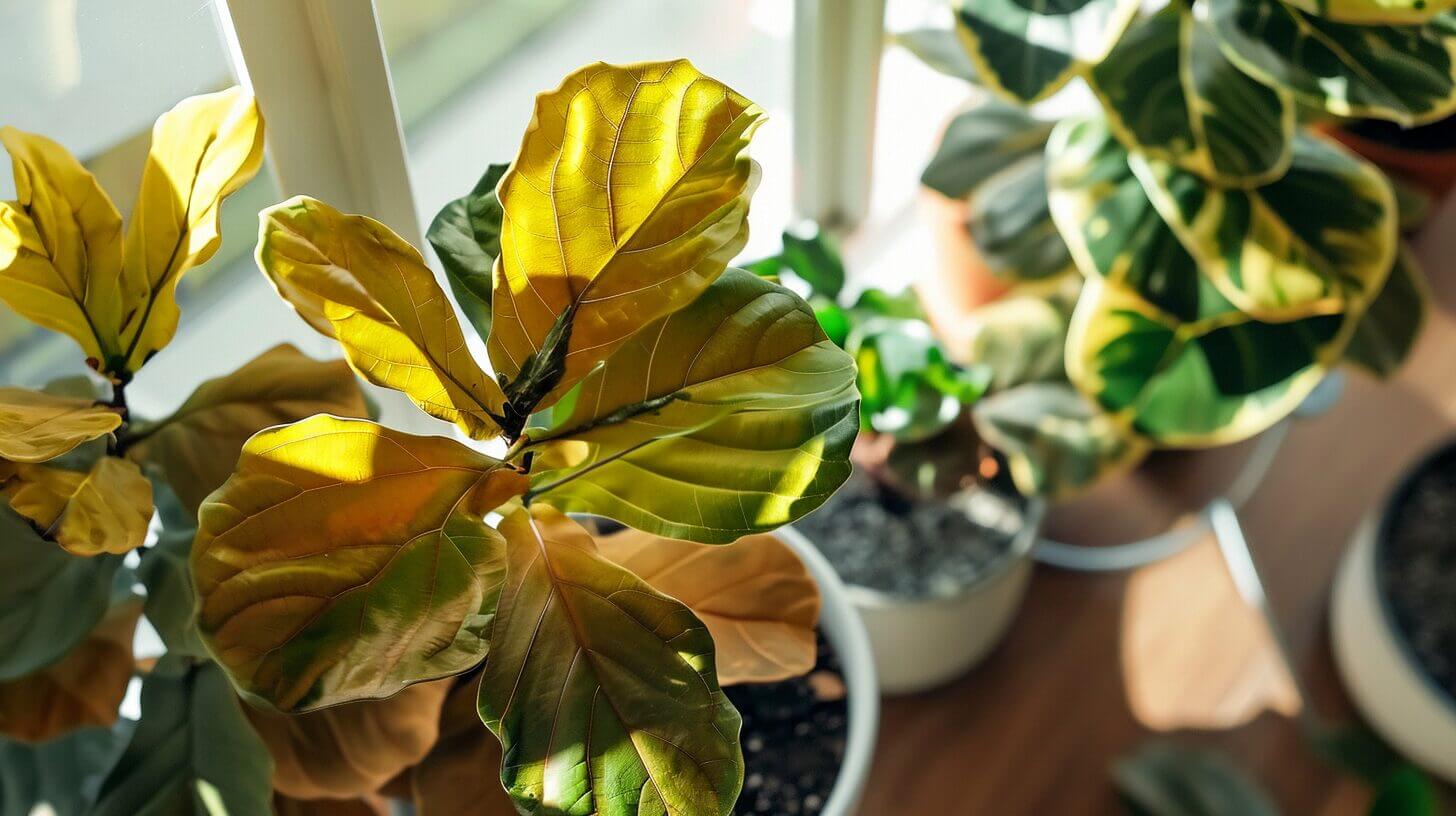
Before you change anything, look at which leaves are yellow. That single detail narrows the cause faster than any other check, and it is the step most guides skip entirely.
Fiddle leaf fig leaves turning yellow from the bottom up mean something different from leaves dropping at random, or from new leaves that come in small and pale. Same symptom, three different problems, three different fixes.
What the Pattern of Yellow Leaves Tells You
Start here. Walk over to the plant and note where the yellow leaves actually are.
| What you see | Most likely cause | First thing to check |
|---|---|---|
| Lowest leaves yellow first, working steadily upward. New growth still green but smaller than usual | Nitrogen shortage | When you last fed it |
| Lower leaves yellow and limp, soil still damp days after watering | Overwatering, possibly root rot | Soil moisture and drainage holes |
| Leaves dropping from top, middle and bottom with no clear pattern | Underwatering or sudden stress | How dry the pot has gone |
| Yellowing with fine webbing, sticky residue or tiny bumps on stems | Pests | Undersides of the leaves |
| One or two lowest leaves yellow slowly, everything else thriving | Normal aging | Nothing. This is fine |

That last row matters. A fiddle leaf fig shedding its oldest leaf occasionally while pushing out healthy new ones is not sick. It is doing what trees do.
Why Bottom Leaves Go First
There is a reason the yellowing so often starts at the bottom, and understanding it tells you how urgent the problem is.
When nitrogen runs short, the plant does not distribute the shortage evenly. It actively pulls nitrogen out of its older leaves and moves it to the newest growth, because new leaves will produce more energy over their lifetime than old ones. The old leaf yellows because the plant deliberately drained it.
This is why bottom-up yellowing with healthy green new growth points to feeding, not watering. The plant is not failing. It is rationing.
Overwatering produces a similar bottom-up pattern, which is where people get stuck. The tiebreaker is texture and soil: nitrogen-starved leaves yellow evenly and stay firm, while overwatered leaves go yellow and droop, usually with soil that is still wet several days after a drink.
The Fix for Each Cause
Nitrogen shortage
Feed it. A balanced liquid houseplant fertilizer at half strength, every two to four weeks through spring and summer, is enough. There is no need for a product marketed specifically at fiddle leaf figs.
Stop feeding in fall and winter when growth slows. Fertilizing a plant that is not growing does not help it and can burn the roots.
Overwatering
Push a finger into the soil to the second knuckle. If it is damp at that depth, do not water. Fiddle leaf figs want the top two inches to dry out between drinks, and they would rather be slightly too dry than slightly too wet.
Check that the pot actually drains. A decorative outer pot with no hole quietly turns every watering into a reservoir. If you are unsure how often yours should be drinking, our fiddle leaf fig watering guide covers seasonal adjustments.

Underwatering
Less common, but it happens with plants in bright spots or small pots. The giveaway is leaves that go yellow or brown at the edges and feel papery rather than limp, plus soil pulling away from the sides of the pot.
Not enough light
A fiddle leaf fig tree in a dim corner cannot photosynthesize enough to keep all of its leaves fed, so it sheds the ones earning least. Older leaves lower down go first, which is why poor light and a nitrogen shortage look so similar.
These plants want bright, indirect light for most of the day, ideally within a few feet of a large window. What they do not want is harsh direct sunlight through unshaded glass, which scorches the leaves and leaves pale bleached patches rather than even yellowing.
If the plant sits more than about ten feet from a window, or the room needs a lamp on during the day, light is a likely contributor no matter how carefully you water.
Pests
Check the undersides of the leaves and the joints where leaf meets stem. Spider mites leave fine webbing, mealybugs look like small white cotton specks, scale looks like raised brown bumps that do not brush off.
Insecticidal soap or neem oil works, applied to both sides of every leaf and repeated weekly until the signs stop. One application almost never finishes the job.
How to Know If It Is Root Rot
If the soil stays wet, the base of the stem feels soft, or the pot smells faintly sour, the only way to be certain is to look.
- Slide the plant out of its pot and rinse the soil off the roots.
- Healthy roots are white to pale tan and firm to the touch. Rotted roots are brown or black, mushy, and often smell.
- Cut away every soft root with clean shears. Keep only firm ones.
- Repot into fresh potting soil in a container with real drainage holes.
- Water sparingly until you see new growth. A plant with fewer roots needs less water, not more.

If you are repotting anyway, it is worth reading up on when a fiddle leaf fig actually needs a bigger pot, since going too large too fast causes the exact waterlogging you are trying to escape.
Should You Cut Off the Yellow Leaves?
You can, and there is one hard limit worth respecting.
Do not remove more than 10 to 20 percent of the foliage at once. A fiddle leaf fig photosynthesizes through its leaves, and stripping a struggling plant of the leaves it still has makes recovery harder, not easier.
Beyond that limit, it is genuinely a preference. Choosing to prune yellow leaves tidies the plant and lets you see new problems clearly. Leaving them costs the plant almost nothing, since a yellow leaf is already spent.
Will the Yellow Leaves Turn Green Again?
Almost certainly not, and this is the part worth internalizing.
By the time a leaf looks yellow, the plant has broken down the chlorophyll inside it and moved the useful components elsewhere. That process does not run backwards. The leaf is finished, whatever you do next.
The single most useful habit here: stop watching the yellow leaf and start watching the newest one. Recovery never shows up in damaged foliage. It shows up as the next leaf coming in full-sized and properly green. That is your real progress indicator, and it will tell you within a few weeks whether the fix worked.
People re-diagnose their plant over and over because the sick leaf never improves, then keep changing variables and stress the plant further. Judge by new growth and you avoid that loop entirely.

When Yellow Leaves Are Actually Urgent
Most yellowing is slow and recoverable. Take it seriously when you see:
- Several leaves yellowing and dropping within a few days
- A soft, dark, or mushy patch at the base of the trunk
- Yellowing together with dark spots that spread outward
- Soil that has stayed soaking wet for over a week
Those point to advancing root rot, where waiting genuinely costs you the plant. Everything else can be fixed at a normal pace.
Frequently Asked Questions
Why is my fiddle leaf fig dropping leaves and turning yellow at the same time?
Yellowing plus dropping usually means overwatering rather than a nutrient problem. Check whether the soil is still damp days after watering and whether the pot drains freely.
What does an overwatered fiddle leaf fig look like?
Yellow leaves that feel limp rather than crisp, starting low on the plant, with soil that stays wet. Brown spots with yellow halos often appear alongside.
How do I know if my fiddle leaf fig is dying rather than struggling?
Look at the trunk and the newest growth. A firm trunk and any new leaf, even a small one, means the plant is still working. A soft trunk with no new growth for months is the serious sign.
Can too much fertilizer turn the leaves yellow?
Yes. Overfeeding builds up salts that damage roots, which produces yellowing that looks much like underfeeding. If you have been fertilizing more than every two weeks, flush the pot thoroughly with water and pause for a month.
How long until I see improvement?
Expect three to six weeks before a new leaf appears, longer in winter. Existing yellow leaves will not change in that time, which is normal.
The Short Version
Look at where the yellow is. Bottom-up with healthy new growth means feed it. Bottom-up with limp leaves and wet soil means water less and check the roots. Random leaf drop means the pot went too dry. Then judge whether you fixed it by watching the next leaf, not the sick one.